
Blogs / India-Wealth-Boom
By Titan Capital
India Has 10 Crore SIPs and Roughly 1,000 Advisers
30 September 2026
The next big wealth opportunity in India isn't access to investing. It's access to advice, and AI is the first thing that can deliver it at the scale of the SIP.
The next big wealth opportunity in India isn't access to investing. It's access to advice, and AI is the first thing that can deliver it at the scale of the SIP.
Picture two colleagues in Gurugram on the same salary band.Onehas three SIPs running, all picked from reels, two of them small-cap funds.The otherhasn't opened her EPF passbook since onboarding, assumes her NPS "is doing something," and has ESOPs vesting at a Series C startup she couldn't put a number on.
Both would say they're investing. Neither has ever had a single conversation about how the pieces fit together.
Money is moving in record amounts. Guidance isn't moving with it.
The Problem
Over the last decade India solved distribution. UPI, eKYC and investing apps made it possible to start a ₹500 SIP in under five minutes. What didn't scale was advice.
Advice has always been expensive to deliver one person at a time, so it went where the ticket sizes were: HNIs and family offices. Everyone else got a distributor, a relative, or an Instagram feed.
The salaried professional has the most moving parts and the least help joining them up: a provident fund (EPF), a pension account (NPS), a few SIPs, and, increasingly, ESOPs
Where the Market Currently Stands
Mutual funds & SIPs
- Monthly SIP contributions hit a record₹32,297 crorein August 2026 (AMFI, September 2026)
- Contributing SIP accounts crossed10 crorefor the first time (AMFI, September 2026)
- Industry assets stood at₹87.08 lakh crore(AMFI, August 2026)
Employee funds
- EPF has paid8.25%for a third straight year, credited to 7 crore+ members (Government ratification, June 2026)
- EPFO's corpus crossed₹28.34 lakh croreas of March 2025 (EPFO Central Board of Trustees meeting, via PIB, March 2026)
- NPS and APY (Atal Pension Yojana, the government-backed pension scheme for unorganised-sector workers) together crossed₹16 lakh crore and 9 crore subscribers(PFRDA, August 2025)
Equity at work
For founders, the companyisthe wealth. For employees, ESOPs are turning into real money too.
- Close to$2 billionin startup ESOP buybacks since 2020 (Entrackr, April 2026)
- $220 millionin Q1 2026 alone, more than all of 2024 or 2025 (Entrackr, April 2026)
- Flipkart's 2025 buyback: ~$50 million to ~7,500 employees (Inc42, 2025)
Who's investing
- India's median investor is now33, down from 38 in March 2020 (NSE Market Pulse, August 2026)
- 59%of new investors registered in April–June 2026 were under 30 (NSE Market Pulse, August 2026)
The advice side
- India has around1,000registered investment advisers, and the number is falling (SEBI Chairman Tuhin Kanta Pandey, March 2026)
- That's roughlyone adviser for every 1 lakh SIP accounts
- Only9.5%of households invest in securities, though63%know about at least one product (SEBI Investor Survey, 2025)
- 74%of non-investors cite complexity as a barrier; 56%first hear about products on social media (SEBI Investor Survey, 2025)
The Gap
India has built a mass-market savings habit without a mass-market advice layer. That gap shows up in three places.
Momentum over plans
- Small-cap, mid-cap, flexi-cap and thematic funds took49.8%of all SIP inflows in August 2026 (Business Standard, analysing AMFI data)
- At the extreme end, individual traders lost₹1,05,603 crorein F&O in FY25, and 91%+ of them lost money (SEBI study, July 2025)
SEBI Chairman Tuhin Kanta Pandey flagged the same problem at ARIA's Aspire 2026 event: with adviser numbers shrinking, the gap is increasingly being filled by unregulated voices such as influencers, who pass off opinion as expertise (News On Air, March 2026).
The gap changes with age
The same salaried professional needs very different help at 24, 30 and 38. Today's market serves the first and last stage in pieces, and the middle barely at all.
At 24: the first salary
- What they have: EPF deducted automatically, a ₹2,000–5,000 SIP, maybe a trading app
- What they need: an emergency fund, term insurance before it gets expensive, the habit of not touching the SIP, and someone to talk them out of F&O
- Who serves them: apps built for transactions, and finfluencers. The ticket size is too small for any human adviser to make money on.
At 30: the salary jump
- What they have: SIPs spread across two or three apps, ESOPs from their second or third job, a partner's finances to combine, a home loan on the table
- What they need: one view of everything, overlap checks, a buy-vs-rent call, ESOP exercise and tax planning, and a switch from "saving" to "goals"
- Who serves them: almost nobody. They're too big for a DIY app to guide properly and too small for a wealth manager's RM.
At 35–40: the sandwich years
- What they have: a real corpus across EPF, NPS, MFs and property, kids' school fees, parents' health costs
- What they need: retirement maths, education funding, insurance for parents, an estate and nomination clean-up, and rebalancing away from the employer's stock
- Who serves them: RM-led wealth firms, once they clear the ticket size. SEBI requires a minimum of ₹50 lakh for PMS and ₹1 crore for AIFs, so most people at this stage get one product at a time, not a plan.
Owning isn't the same as cashing out
Building a company or owning shares where you work can grow your wealth. You just need to know what you own and when you can cash out. Most employees know how many options they hold. Far fewer know:
- their vesting schedule
- how long they have to exercise if they leave
- that exercising is taxed as salary, even if the shares can't be sold yet
- that only DPIIT-recognised startups with turnover under ₹100 crore can defer that tax
A worked example 10,000 options × (₹510 fair value – ₹10 strike) =₹50 lakh taxable incomeTax at the top slab: ₹15 lakh+Buyer for the shares: none yet
And then there's concentration. One company ends up paying your salary and holding a big chunk of your net worth. Almost nobody mentions that at the offer stage.
The gap isn't another fund or another app. It's the missing layer that looks at EPF, NPS, SIPs, ESOPs and salary together and says what to do next, including when to do nothing.
Where does the opportunity stand?
AI changes the economics, not just the interface. A human adviser can manage a few hundred relationships. An AI system can, for almost nothing at the margin:
- read a consolidated statement and flag that three "different" SIPs hold the same stocks
- explain why an 8.25% EPF is doing more work than it looks
- model the tax cost of exercising ESOPs now versus waiting for a buyback
- nudge someone to hold during a drawdown, in Hindi or Tamil, at 11pm
The catch: regulation
In India, personalised advice, whether it comes from a person or a model, has to come from a SEBI-registered investment adviser. The adviser stays fully responsible for whatever its AI tools say, and it has to tell clients how much AI it uses (SEBI Investment Adviser amendments, December 2024). Advice and product distribution also have to sit in separate entities at the client level. So the platforms with mass reach can't simply switch on AI advice for their users. Whoever works out a compliant, fee-based way to advise at SIP scale gets a real head start.
The big platforms are already buying their way in
- Groww bought Fisdom for about $150 million in May 2025. Fisdom brought ₹10,000 crore+ in AUM, ~150 wealth advisers and PMS/AIF licences, and its research team now powers Groww's AI mutual fund tool, MF Prime (Inc42, 2026)
- Dhan's parent, RAISE, is acquiring Infinyte Club, a startup that helps startup employees access private markets and get liquidity on ESOPs, at a $13–15 million valuation. Infinyte's co-founder will lead Raise's wealth business (Entrepreneur India, April 2026)
- Angel One built rather than bought.Its wealth arm, Ionic Wealth, crossed $1 billion in AUM within 22 months, targeting affluent and HNI clients with a tech-plus-adviser model (Angel One, 2026)
What it means: India's largest brokers already own the customer and the transaction. What they're missing is the advice layer and the licences that come with it. They're paying for it now because that's where they think the next margin sits.
Established players are adapting
- Dezerv started as an RM-led wealth manager for affluent investors and now manages ₹14,000 crore. It raised ₹350 crore in October 2025, and its app lets 5 lakh+ users track ₹2 lakh crore in assets they hold elsewhere, which widens the funnel well beyond its paying clients (Business Standard, October 2025)
- AssetPlus bet on the distributor rather than going around them. 18,000+ mutual fund distributors use its platform to serve ~1.5 lakh investors, and it raised ₹175 crore in January 2026 to build "wealth management infrastructure that combines human advice with technology-led scale" (Inc42, January 2026)
- Centricity WealthTech gives independent advisers the platform to run their own practice, with a B2B2C model aimed at the emerging affluent, HNIs and NRIs. It raised $33 million in August 2026 at a ~$216 million valuation (FinTech Global, August 2026)
The common thread: nobody is betting on pure robo or pure human. The money is going into hybrid models where technology does the heavy lifting and people step in where trust matters.
The new wave, funded in the last year
- PowerUp Money: zero-commission mutual fund advisory. It raised a $12 million Series A led by Peak XV in December 2025, six months after its seed round (Business Standard, December 2025)
- Otto Money: AI-led, multi-asset guidance that doesn't sell products. It raised a $1.3 million pre-seed led by Pravega Ventures in February 2026 (Entrackr, February 2026)
- Novelty Wealth: a SEBI-registered adviser that aggregates accounts and gives AI-driven advice through its assistant, NovaAI. It raised $1.4 million led by IndiaQuotient in March 2026 (Business Standard, March 2026)
All three are betting on the same thing: advice that's cheap enough for the 30-year-old in the middle.
Where to Build Next
The infrastructure is getting crowded. The next opportunities are in specific customers and the gaps nobody has closed yet.
What's copyable, and what isn't
- Easy to copy: account tracking, AI chat, goal calculators. These will be table stakes within two years.
- Hard to copy: licences, trusted distribution, behavioural data, and deep knowledge of one customer type.
Niches by customer type
- First-jobbers (22–27): help managing monthly expenses and building the saving habit, so the SIP survives the first market dip
- Startup employees with ESOPs: exercise planning, tax, liquidity and diversification. Raise buying Infinyte is an early signal
- Mid-career households (28–35): one combined plan for two incomes, a home loan and future planning, so their products work together instead of in silos.
- NRIs: cross-border tax, repatriation and investing back home (Centricity is already targeting them)
- Women investors: only ~25% of India's investor base, according to the NSE (August 2026)
- Tier-2 and tier-3 India: vernacular advice, most likely delivered through local distributors rather than around them
- Pre-retirees (50+): turning an EPF, NPS and FD corpus into a monthly income
A market map of Indian wealth-tech
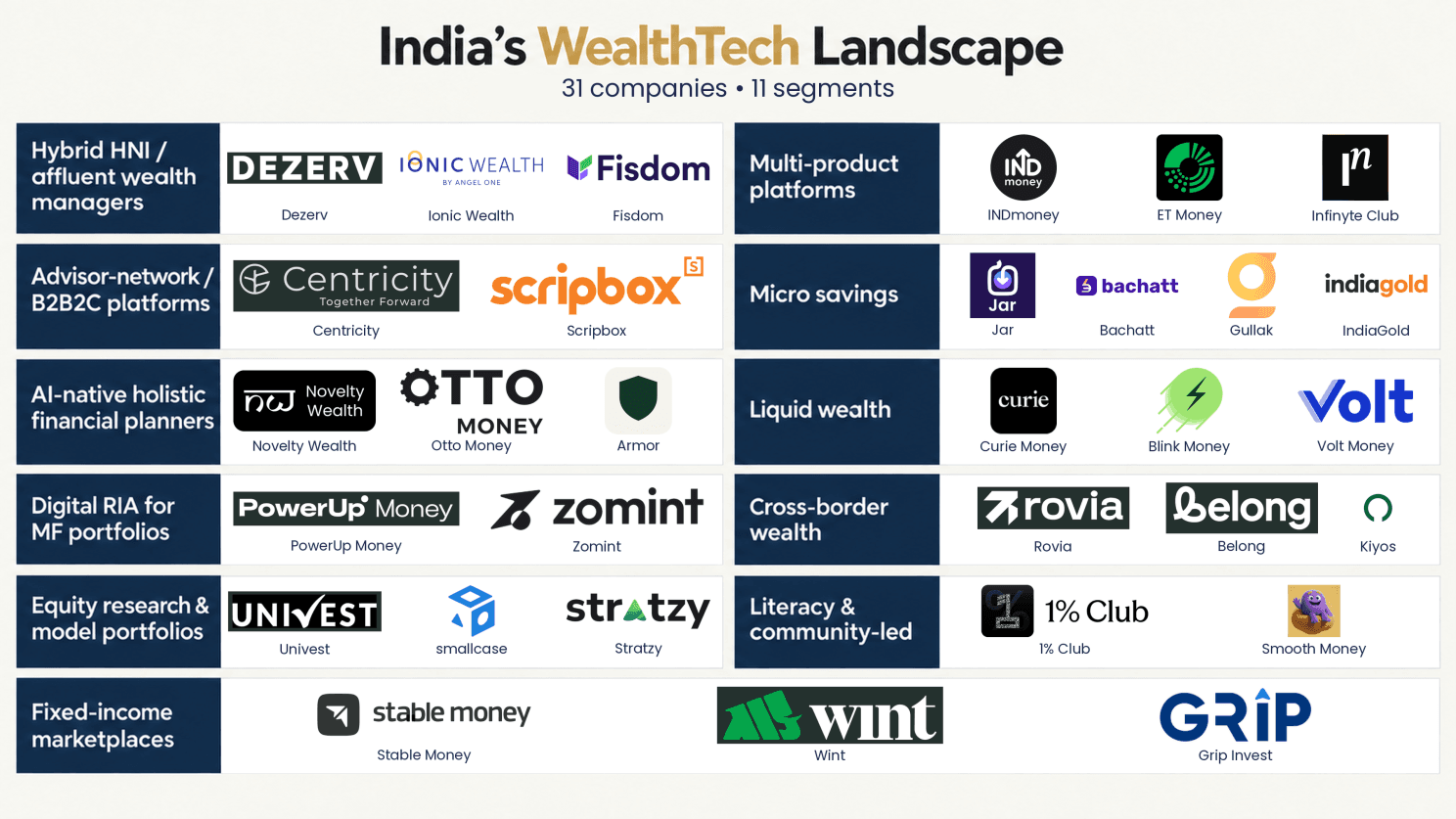
Crowded vs open
- Crowded:broking, direct mutual fund distribution, and RM-led wealth for HNIs
- Still open, in our view:ESOP planning for employees, wealth advice inside the employer's HR stack, retirement income, and planning for the whole household, not one account
How This Helps
For the individual
- The SIP stops being a standalone habit and becomes part of a plan
- EPF, NPS and SIPs add up to a visible retirement number, so there's less temptation to chase last quarter's small-caps
- ESOPs become something you plan around, not a lottery ticket
For the market
- The next 10 crore investors come in with guidance instead of guesswork
- The first wave of Indian wealth-tech got people to invest. The next wave will help them stay invested sensibly, and that's where we think the more durable companies will be built.
India has already proven that crores of people will put money aside every month. The open question is who they'll trust to tell them what it all adds up to: an algorithm that has to show its working, or the loudest voice in their feed?
Building something?If you're a founder working on any of these gaps, we'd love to hear from you. Apply athttps://titancapital.vc/getinvestment