
Blogs / anthropic-ipo
Titan Capital · Category: Insights
Anthropic S-1: $16.3B in H1 revenue, 14x YoY. What should investors ask beyond reported numbers?
27 October 2026
An inquiry beyond the splendid growth

When Claude first became widely available in 2023, we tried it with fervour but ultimately dismissed it. ChatGPT had already taken the world by storm and become familiar enough that I didn't want to start again with what felt like a 'me-too' product.
Dario Amodeikept making a different case: Anthropic's focus on enterprises would make it a different kind of frontier AI company. But for many of us, that distinction didn't change much in our day-to-day lives. Developers were still copying code into GPT-4 and pasting the output back into their editors to see if it worked.
Claude Code changed that. It became generally available in May.Anthropicbegan to look much more like the company Amodei had been describing.
By the time Amodei came to the IndiaAI Impact Summitin February 2026, India was alreadyClaude.ai's second-largest market. The pace was showing up in valuations too:Anthropicwent from a $380B post-money valuation in February to $965B in May, roughly 2.5x in just over three months.
Now the S-1 shows how much of that played out in the numbers.
- Its enterprise emphasis (notably it doesn’t track ‘enterprise’ as a category and uses $100K+ customers as a proxy) is clear, but the revenue categories need a double click. In H1 2026, 80% of revenue was “consumption-based”: customers paying for usage, metered in tokens. The remaining 20% came from subscriptions. Some consumption contracts include minimum spend commitments, and subscriptions serve both businesses and individuals. It’s a split by how customers pay, not by who they are.
- The filing also lays out the staggering pace of growth. Revenue reached $16B in January to June 2026, up from $1.1B one year earlier. That is a 1,300% increase, or 14x.
Nor is there much doubt about the potential of frontier AI. The filing describes applications ranging from drug discovery to cybersecurity and complex knowledge work.
The question for a new investor is what price makes this extraordinary frontier lab a good investment.
Suppose Anthropic ends 2026 with $50B in revenue and is valued at $2 trillion. That would be 40x annual revenue. Even at an assumed 20% net margin, it would be 200x earnings. With no cash dividends expected in the foreseeable future, the investment decision then rests heavily on future growth and the earnings it can eventually produce.
With that in mind, we break down the impressive parts and the questions a new investor should inquire.
First the obvious strengths
- Revenue has gone from $41M in 2023 to $386M in 2024, $4.6B in 2025 and $16B in H1 2026 alone.
- Anthropic reports $1.6B in adjusted operating profit in H1 2026, a 10% margin. Its GAAP operating loss was $693M; the difference largely reflects excluded stock-based compensation.
- The much larger $80B GAAP net loss included $72B in non-cash fair-value charges on financing instruments. Similarly, the $132B accumulated deficit is not cash burn: $113.2B relates to fair-value changes. Simply subtracting those charges does not give us cash burn either.
- As of June 30, 2026, Anthropic had $112B in cash + equivalents, $19.3B in short-term investments and $3.2B credit facility.
- Enterprise customer spending has scaled rapidly. By September 30, 2026, more than 1,900 customers generated at least $1M each in trailing twelve-month revenue.
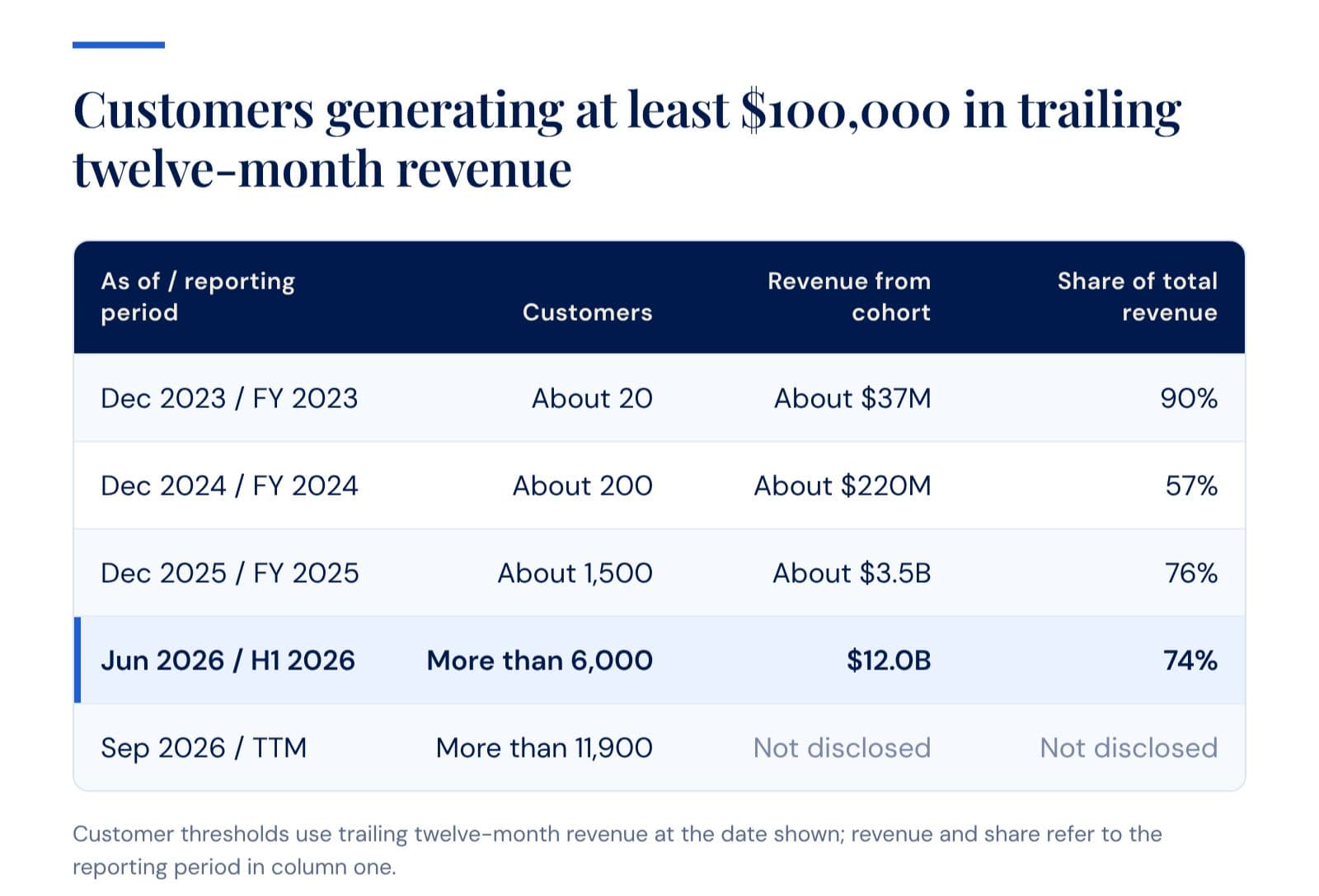
The $100,000-plus customer base includes every Fortune 10 company, more than half the Fortune 500 and over 30% of the Global 2000.
- Net revenue retention was approximately 900% as of September 30, 2026. That means 9X the quarterly revenue from the same customer cohort a year earlier. I would still have loved to see gross revenue retention to understand how much churn and contraction that expansion is masking.
- Compute economics have improved. Revenue per dollar of compute and infrastructure expense rose from about $0.50 in H1 2025 to $1.82 in H1 2026. Better algorithms and utilisation matter, but so does growing revenue against capacity committed in advance. This is a notably improvement, rather than a direct measure of inference margins.
- Trailing twelve-month revenue per employee also rose from $1.4M to over $6.6M between September 2025 and September 2026.
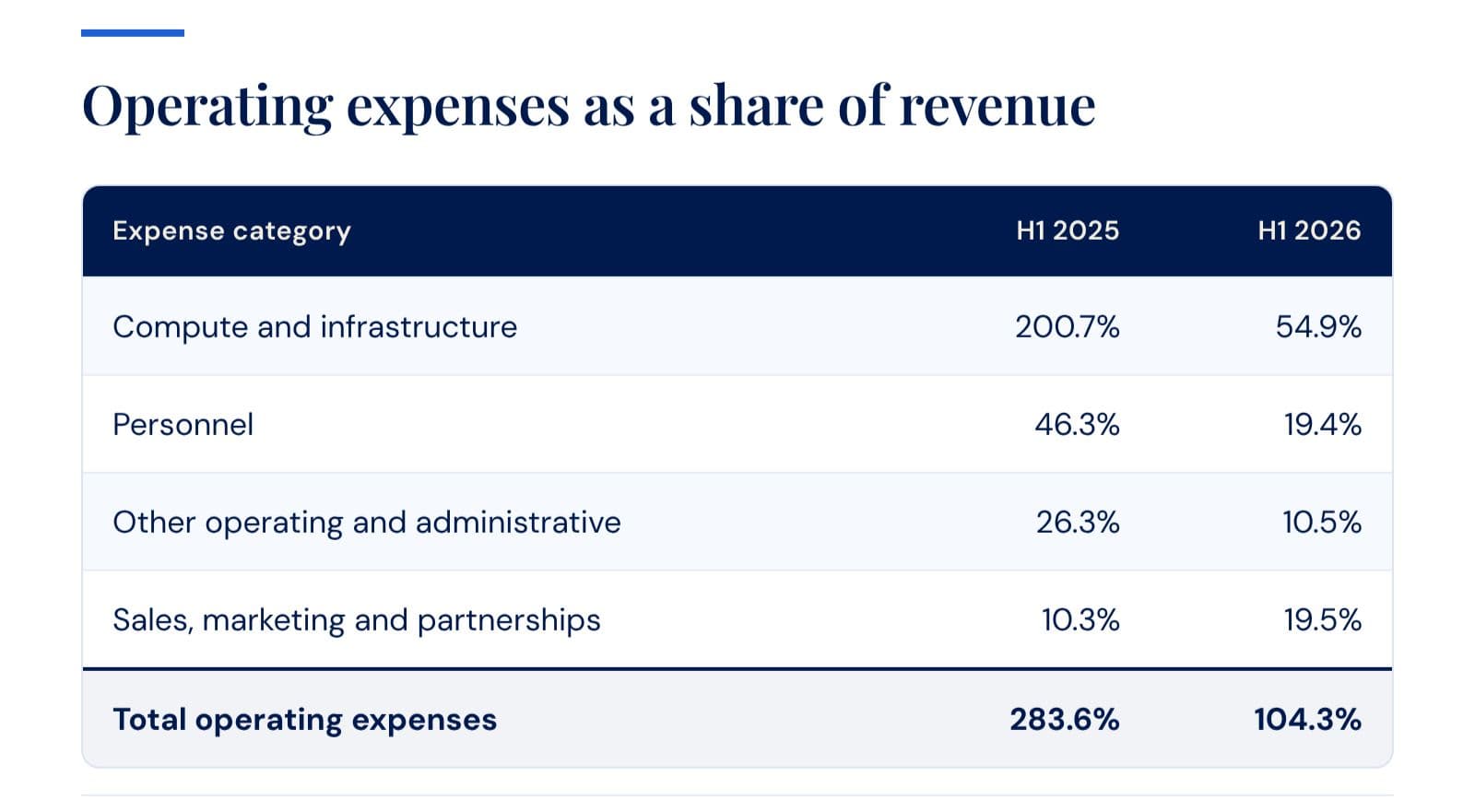
Compute accounts for most of the improvement in operating margin: revenue grew 14x while compute expense grew 3.8x. Sales, marketing and partnerships was the only major expense category that increased as a share of revenue.
The next compute cycle will still matter. The filing leaves aggregate amounts blank for commitments extending as far as 2045, and warns that new capacity and more expensive short-term compute could compress margins.
What a new investor should enquire about
Who is driving enterprise demand? The filing gives us spending tiers, but I would like a clearer split between large enterprises, mid-market companies and AI-native startups, alongside revenue from the platform versus first-party applications. A customer spending $1M can represent very different demand depending on what its business does.
There is useful disclosure on concentration: the top 5 customers accounted for 21% of Q3 2026 revenue, down from 36% in Q1. The next question is how durable the spending is across these different customer groups.
Wallet share or plateau?
Anthropic says its revenue from qualifying Fortune 500 customers averaged <0.1% of their total expenses in Q3 2026. Its top 10 Fortune 500 customers spent 8X that average share.
To put in perspective, total software and payroll spent by companies as % of revenue is 4-6% and 12-14% respectively.
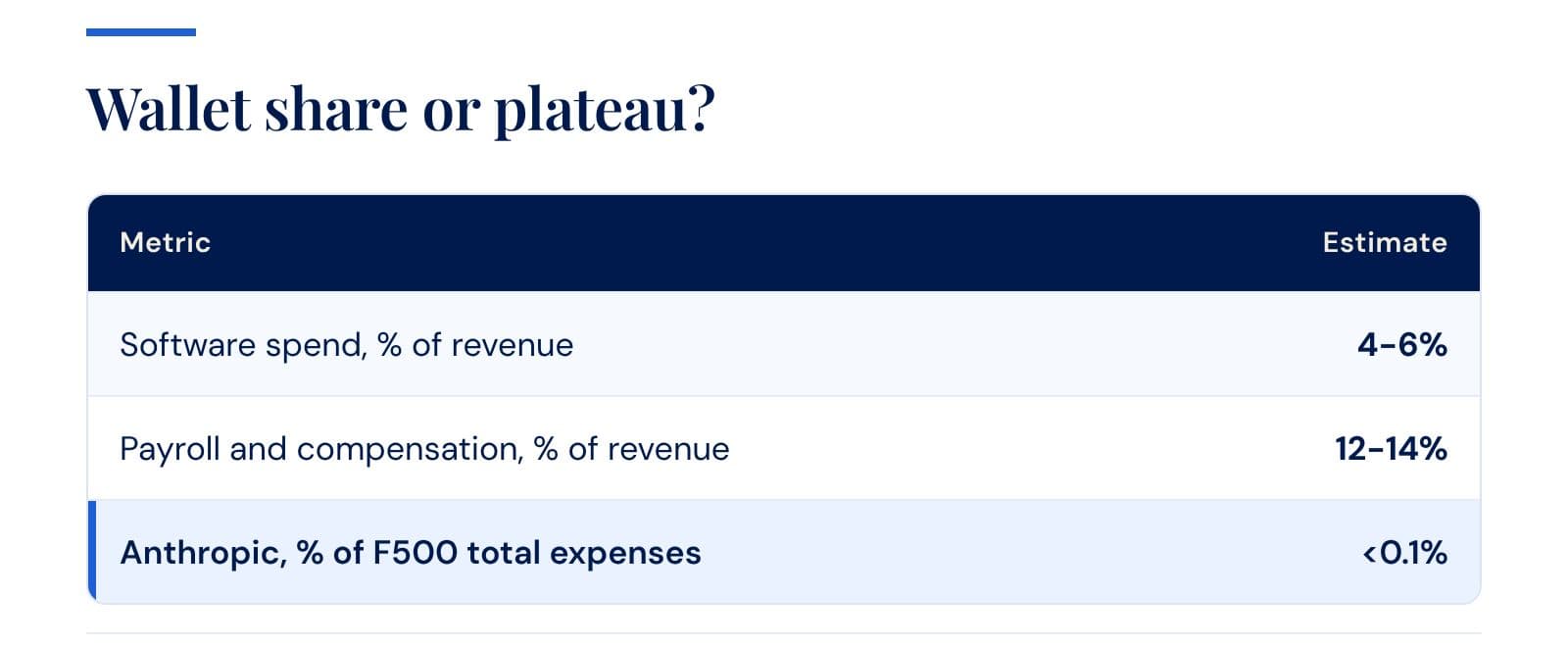
There are two ways to read this. Anthropic ofcourse sees substantial room to expand.
The other possibility is that enterprises face practical limits on how much work they can reliably hand over to AI today. Total corporate expenses are a very broad denominator. The useful question is how much addressable work Claude can capture, at what price and with what return for the customer.
Geography split of revenue is also much needed. The filing discloses that ~72% of H1 2026 revenue came from US billing addresses and 28% internationally. What it does not show is that split separately for consumption and subscription revenue, which would help us assess demand and competitive alternatives in each market.
Then there is model mix. New customers, more tasks per customer, more tokens per task and changes in pricing or model mix can all drive revenue. The filing says models released in the preceding six months generated over 80% of Q3 2026 revenue. But how much comes from the most capable models versus cheaper models serving routine work? That distinction matters for both pricing power and margins.
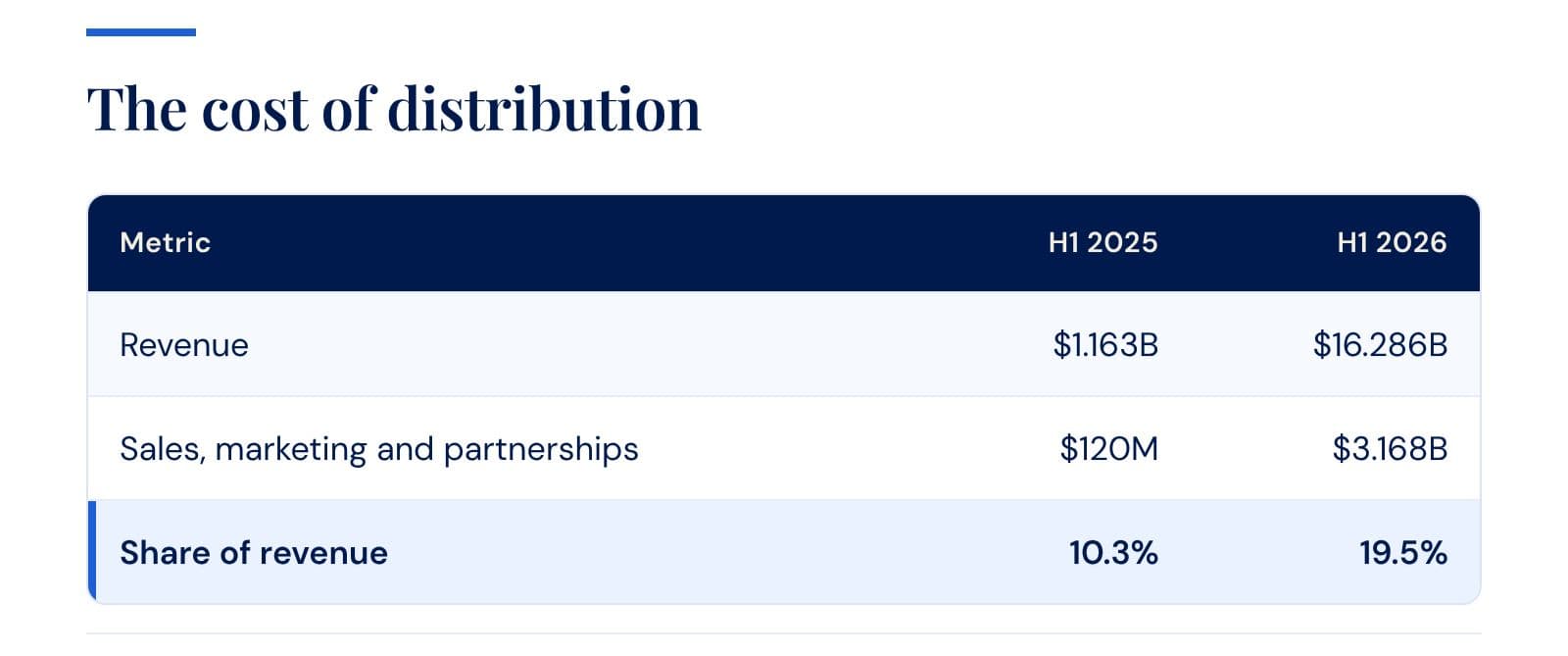
Sales, marketing and partnerships expense grew 26.4x while revenue grew 14x. At first glance, that might suggest adoption needs a harder push. But the filing attributes $2.7B of the $3B increase to channel-partner fees. The sharper question is how much of future revenue must be shared with distribution partners, and whether that share keeps rising.
Competition beyond the frontier
The filing namesGoogleandOpenAIas primary competitors and acknowledges pricing pressure from open-weight and open-source models. It also recognises that customers may decide cheaper models are good enough for particular tasks.
What I would like to understand better is how Anthropic expects to defend its economics across those tasks. How much enterprise spending requires the “frontier”, and how much could move to alternatives such asMistral,Qwen,Kimi AIorDeepSeek? AI adoption can keep growing without every dollar going to the most capable closed model.
Control and accountability
Finally, the voting structure. A Founder LLC, initially comprising seven co-founders, will hold Class F stock carrying a fixed 50.1% of voting power on matters submitted to shareholders generally. That voting share does not shrink with new share issuance. Separately, the Long-Term Benefit Trust generally elects a majority of the board. Public investors will have limited influence over who controls the company.
There are sunset and accountability provisions. Founder control can end after fewer than three qualifying Continuing Founders remain for 90 days, followed by a 450-day transition. Trustees can also be removed under specified procedures. But there is no simple calendar expiry for the overall arrangement, and control remains tightly concentrated.
The concern is how effectively those checks will work when founder priorities, public-benefit goals and shareholder returns pull in different directions. AI is moving fast. Investors should understand how this structure can adapt with it.
Over the next few days, the same spectacular growth numbers will make headlines and talking points. Anthropic has built an extraordinary frontier AI business. But the valuation, how durable the economics are, and where it fits and leads as AI keeps shifting are still open questions.
Source: Anthropic S-1, filed 26 October 2026.