
They Had No Experience in Beauty. They Built India's First Listed D2C Company.
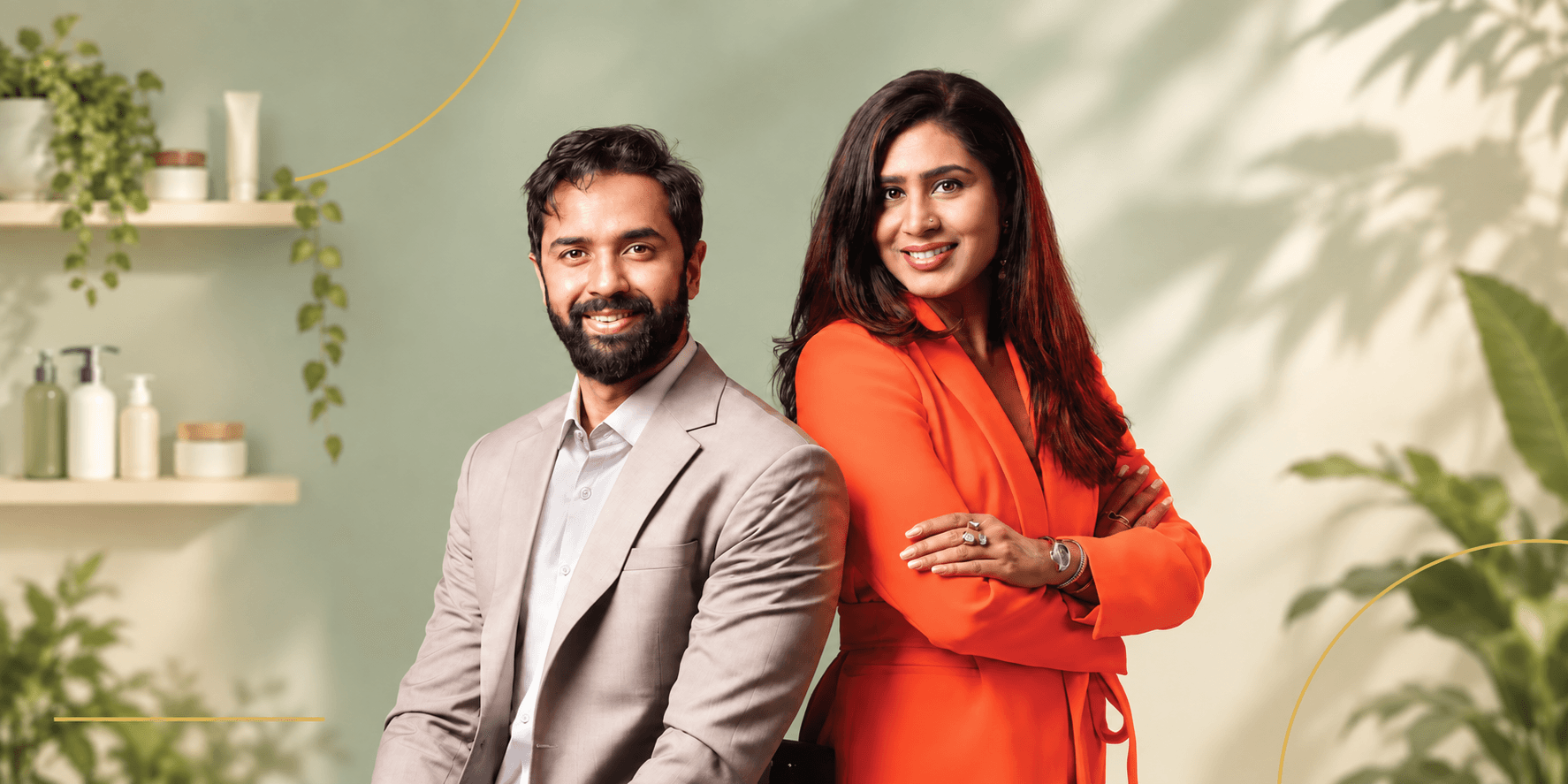
Ghazal Alagh & Varun Alagh — Mamaearth
Before Titan
The company started with a problem the Alaghs couldn't solve as customers.
When their son was born, Ghazal and Varun went looking for baby products that didn't contain things they'd have to look up. They found very little. What was on Indian shelves was formulated for a market that had never been asked the question, and the labels weren't written to be read. Friends travelling abroad began carrying products back for them. Before long, other parents were asking the Alaghs to do the same.
Neither had built a consumer brand. Varun had spent twelve years in corporate India — Hindustan Unilever, Infosys, then Coca-Cola, where he ran brands across four markets. Ghazal had worked in technology and trained corporate teams, with a parallel life in art.
Varun left Coca-Cola in November 2016. They put in their own savings, took a small amount from angels, and launched with seven products and a single promise: nothing toxic, ever.
The bet
Titan's involvement began with a bottle in Kunal's bathroom, put there by his wife after she'd come across the brand in a mothers' group online. He called the feedback number printed on the back, which was picked up directly by co-founder Varun Alagh.
What the conversation surfaced was the thing that usually decides these calls: two founders who spent money as though it were their own, because it was. Early on, offered a celebrity endorsement they couldn't afford, they structured it as equity rather than cash. It preserved the balance sheet and it told us what they believed their shares would eventually be worth.
We invested in 2017. At the time, D2C was not a thesis anyone in India had written down, and beauty and personal care was not considered a venture category. The company had a handful of products and no meaningful distribution. We were not backing a market. We were backing two people who understood a customer better than the incumbents did, on the assumption that the market would arrive later.
It did.
The hard part
There was no single crisis. That is the part of this story hardest to write and probably most useful to read.
For most of the years we held the company, Mamaearth was building in something that wasn't yet an investment category. No listed comparables in India, no accepted way to value a consumer brand that sold mostly online, no consensus that one could reach the scale this one was aiming at. Every round started from first principles rather than a benchmark. That stretch is harder on founders than a crisis is. A crisis is legible where everyone agrees there's a problem and it ends. A long middle doesn't. The company is neither failing nor obviously winning, and the founders carry the argument on their own for years. An early investor's contribution in that period is mostly steadiness. We stayed on the register and put in more, kept backing the thesis we'd underwritten at the start, and held the same view throughout: the category would arrive, and the answer to it not having arrived was to keep building rather than to become a company with comparables.
The test came at the end. Honasa filed in December 2022 and listed eleven months later, into a market that had spent the year repricing consumer businesses from growth to profit. The window was never going to be the one anyone had imagined at filing. They went anyway.
What it became
Seven years after two people with no experience of building a consumer brand launched seven products from a house in Gurugram, Honasa was a public company.
The year that followed was not a victory lap. The company began rebuilding how it reached stores, moving off a layer of super-stockists onto a leaner direct model. It was the right structural call and it cost more than anyone had modelled: an inventory correction, a swing to a quarterly loss, and a public loss of confidence arriving when a newly listed company can least afford one. Varun said on an analyst call that they had underestimated the depth of the margin impact. Ghazal wrote publicly about what the criticism had felt like, and asked for time.
Both of those things are worth recording, because founders who have taken a company public generally learn to say less, and these two said more.
The surgery worked. Margins recovered and then expanded. The newer brands in the house: The Derma Co., Aqualogica, BBlunt, Dr. Sheth's, all began growing faster than the flagship, which is the only real test of whether a house of brands is a strategy or a description.
Honasa today is a listed, multi-brand consumer company, still led by the people who founded it. We have written a great many cheques since and very few have compounded the way this one did, but that is the least interesting thing about the story, which is why it is at the end.
In their words
"We built Honasa Consumer with a lot of love and governance. Always thinking about how we can leave a legacy through our brands built for India. We are proud of what we've achieved. But our focus is on the future."
Explore Stories


"Nobody wants a marketplace of plumbers. They want the plumber to show up and do the job well."
Abhiraj Singh Bhal, Varun Khaitan & Raghav Chandra, Co-Founders, Urban Company


"Whatever is unsexy, there's more profit. Everybody wants to be glamorous, so that's where the competition is."
Asish Mohapatra, Ruchi Kalra, Bhuvan Gupta & Vasant Sridhar , Co-Founders, OfBusiness


"Everyone in payments was chasing the biggest merchants. We built for the smallest ones and grew up with them."
Harshil Mathur & Shashank Kumar, Co-Founders, Razorpay
Every company above started with a single conversation. An idea, a problem, and a founder who was obsessed enough to not let it go. If you're building something real, we want to hear about it